
How to Check Criminal History in Lee County
A sound Lee County criminal records search begins with the kind of event, not with the broadest database. The free Lee County Public Index is the first stop for a filed General Sessions case and participating summary matters. Bishopville Municipal Court may not send all of its records to that index, so a city charge also calls for a direct court check. A recent arrest adds two more custodians: the arresting agency for its report and the Sumter-Lee Regional Detention Center for booking and custody data.
Use a full name, known spelling variants, an approximate date, and a case or report number when one is available. Do not add every search filter at once. The Judicial Branch manual says Public Index criteria work together with AND logic, so one wrong date or court choice can hide a valid result.
- Search the Lee Public Index by a complete case number or a lightly filtered name.
- Call the correct summary court when a city, traffic, bond, or magistrate matter is missing.
- Ask the arresting agency or detention center for the distinct incident or booking record.
- Use SLED CATCH for the separate South Carolina fingerprint-supported history.
- Get a certified file from the clerk when proof of the court's own action is required.
Lee County Criminal Case Search Fields
The Lee County Public Index accepts far more than a name. General Sessions numbers follow the pattern YYYYGS31 plus five digits, with 31 identifying Lee County. Summary numbers use YYYYA31 plus eight digits. Name searches can use beginning text, partial words, or the Contains option. Date Type changes what a date range means, so filed, disposed, judgment, and arrest-made dates should not be mixed without a clear reason.
The official Lee Public Index screen shows the county search route used for these court records.
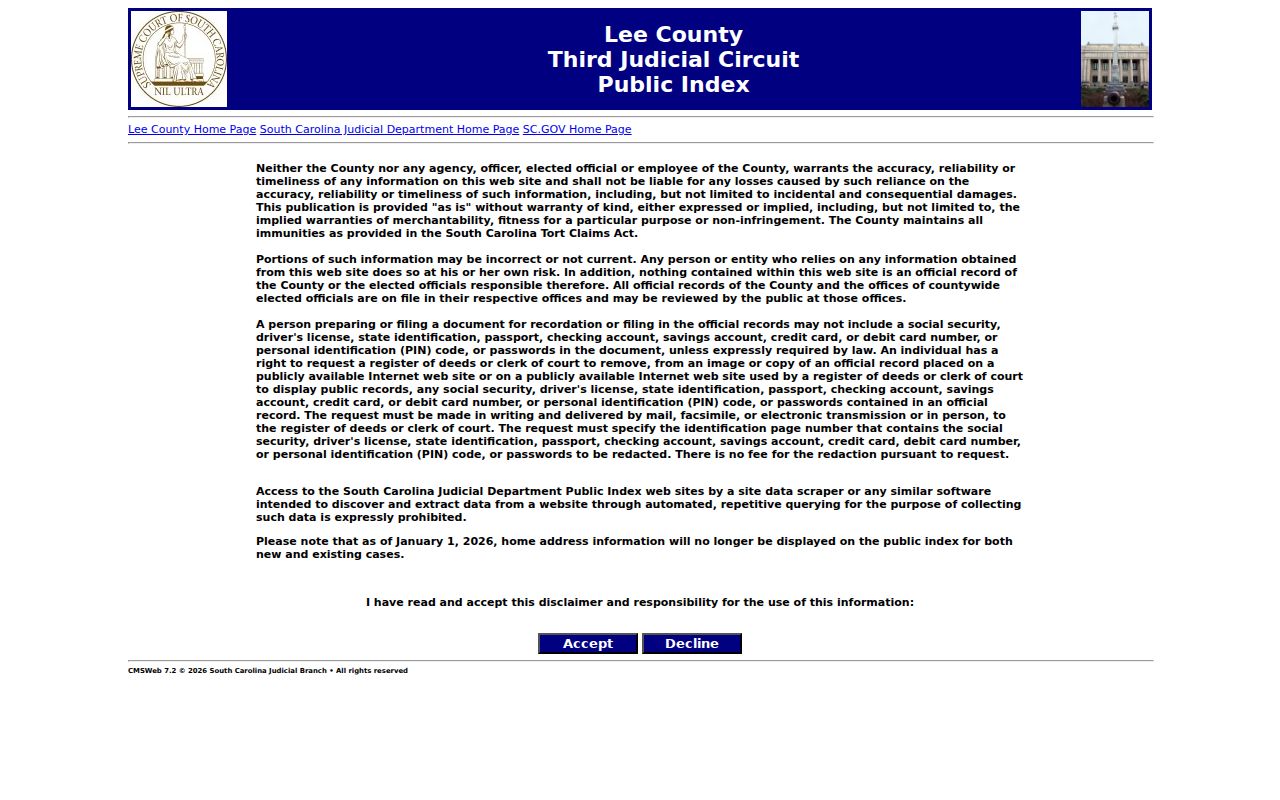
The image reinforces why a court search needs the correct county and court fields instead of a broad name alone.
| Control | Best use | Lee detail |
|---|---|---|
| Case number | Exact known file | GS31 marks General Sessions |
| Name or business | Beginning or partial name | Verify common-name matches |
| Court agency | Narrow the venue | Do not assume municipal coverage |
| Date type and range | Find one event window | All chosen criteria are AND-matched |
| Action type | Narrow a docket event | Not an offense keyword field |
Linked case numbers lead from the result grid to available details. Home addresses were removed from existing and new Public Index cases on January 1, 2026. A portal error or blank search is a cue to remove optional filters and call the clerk, not proof that no case exists.
Official South Carolina Background Checks
The South Carolina Law Enforcement Division runs SLED CATCH, the public name-based view of the state's criminal-history repository. It is South Carolina-only. CATCH does not search wanted-person files, the sex offender registry, a current jail roster, or the complete Lee County court docket. It uses last name, first name, and date of birth with SLED's stated starts-with logic; an optional Social Security number can be included. Name and birth-date matching still lacks fingerprint certainty.
The official CATCH entry page presents the terms and current fee notice for a Lee County criminal history request.
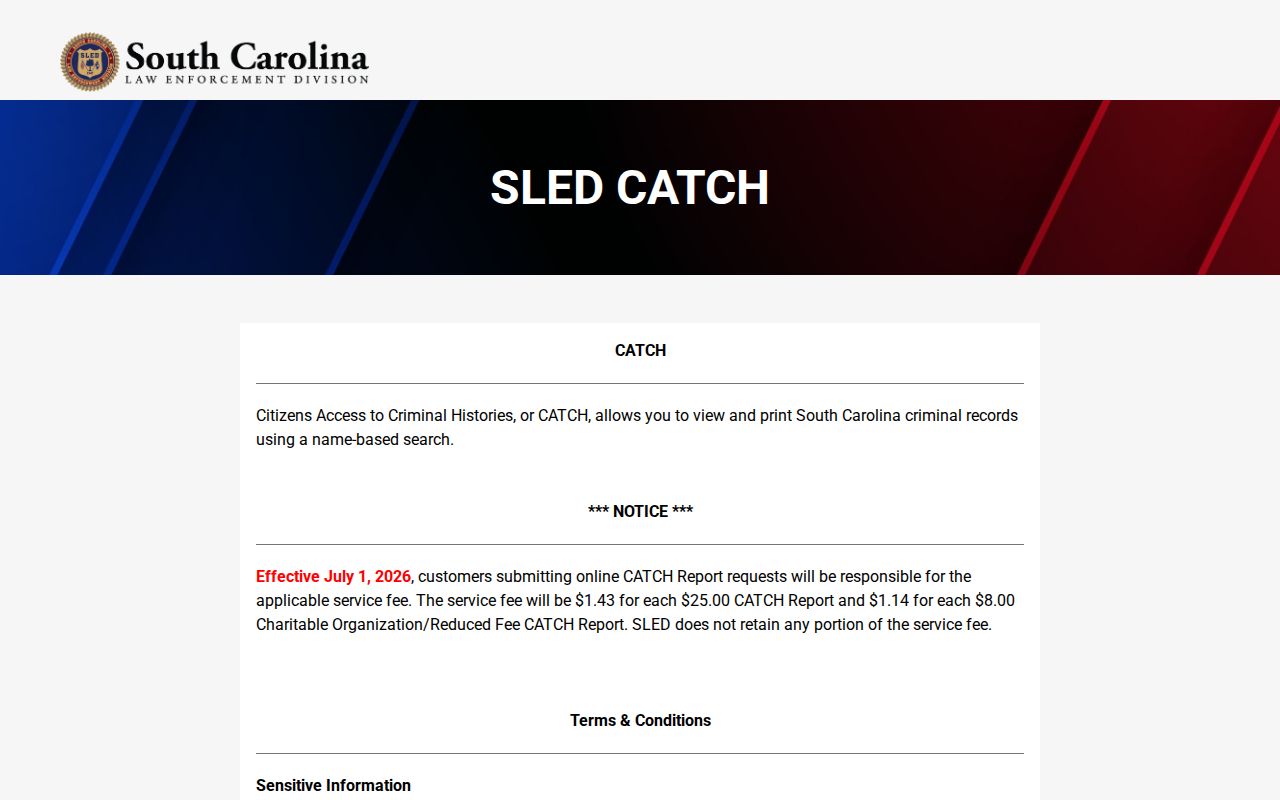
This state product complements the Lee courthouse file rather than replacing it.
| Official option | Current researched cost | Method |
|---|---|---|
| CATCH online report | $25 plus $1.43 service fee | Guest or account access; verify checkout |
| CATCH mail report | $25 | Official form, approved funds, and SASE |
| FBI Identity History Summary | $18 | Fingerprint-based self-review |
The online total is $26.43 under SLED's notice effective July 1, 2026. A mailed request goes to SLED Records Department, PO Box 21398, Columbia, SC 29221-1398. Fingerprint checks are available only for authorized purposes; SLED directs authorized fingerprint capture to local law enforcement or IdentoGO, while an individual seeking a national self-review uses the FBI process.
Lee County CATCH Versus Court Records
CATCH and the Lee County courthouse answer different questions. The court file shows how a filed charge moved through arraignment, motions, plea or trial, disposition, and sentence. CATCH shows what SLED's fingerprint-supported repository presently associates with the searched identity. The two can differ when fingerprints were not captured, an alias or birth date varies, or a final disposition has not yet been linked.
The Judicial Branch Lee County court directory identifies the offices that hold the underlying court files.
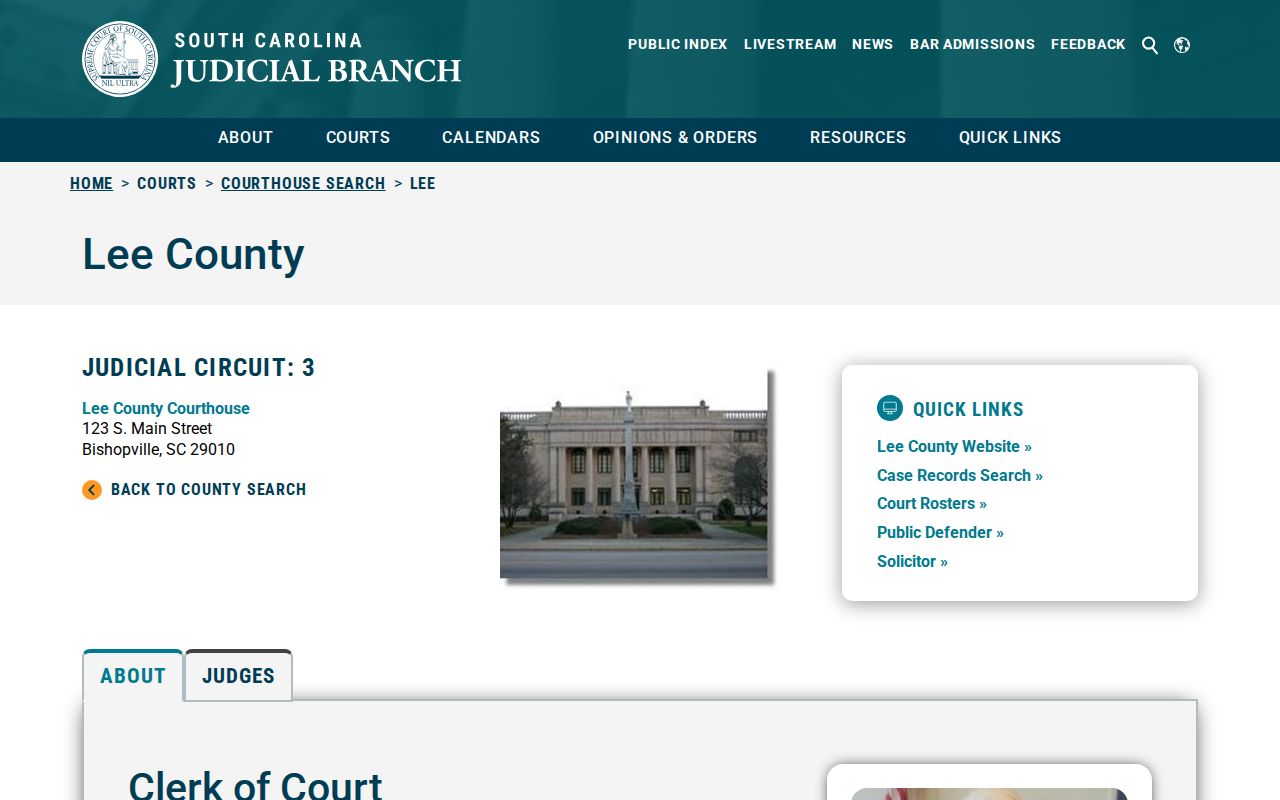
That directory is the fallback when an online criminal case entry is absent, incomplete, old, or needs certification.
Clerk of Court
123 S Main St
Bishopville, SC 29010
803-484-5341
Magistrate and Bond Court
115 Gregg St
Bishopville, SC 29010
803-484-6463 / 803-428-6762
Bishopville Municipal Court
114 E Council St
Bishopville, SC 29010
803-484-5309
General Sessions is the criminal division of Circuit Court. Magistrate Court handles summary matters, Bond Court handles bond proceedings, and Bishopville Municipal Court hears qualifying city and traffic cases. Search the court that actually received the charge.
Types of Criminal Records in Lee County
One event can create several Lee County criminal records. Police may write an incident report without making an arrest. An arrest adds a custody record, while intake at Sumter-Lee creates booking, property, fingerprint, charge, and custody material. If prosecutors file the matter, the clerk opens a court file. SLED may then connect the arrest and later court outcome to its state history.
- Incident report
- The responding agency's account of the call, alleged event, and investigation.
- Booking record
- The detention center's intake and custody file, distinct from the police report.
- Case docket
- The clerk's dated list of filings, hearings, and court actions.
- CATCH report
- SLED's public South Carolina repository product, based on reported identity-linked events.
- Supervision record
- SCDPPPS data for active probation, parole, or other state community supervision.
Warrants form another record set. Lee County has no official public active-warrant database identified in the research. Call the Sheriff's Office at 803-484-5353 and the issuing clerk or summary court. A person trying to resolve a warrant should speak with the court or counsel rather than rely on a blank web result or arrive without guidance.
Lee County Arrests, Sumter Jail Records
Lee County does not list its own adult detention center. Custodial arrests route to the Sumter-Lee Regional Detention Center at 1250 Winkles Road in Sumter. The arrest stays tied to the Lee agency and Lee courts, but the booking and present custody inquiry sits with the regional center. Call 803-436-2340 because no dependable current official online roster was confirmed.
State prison is a separate channel. The official SCDC Inmate Search covers people serving South Carolina prison sentences and uses data through the prior midnight.
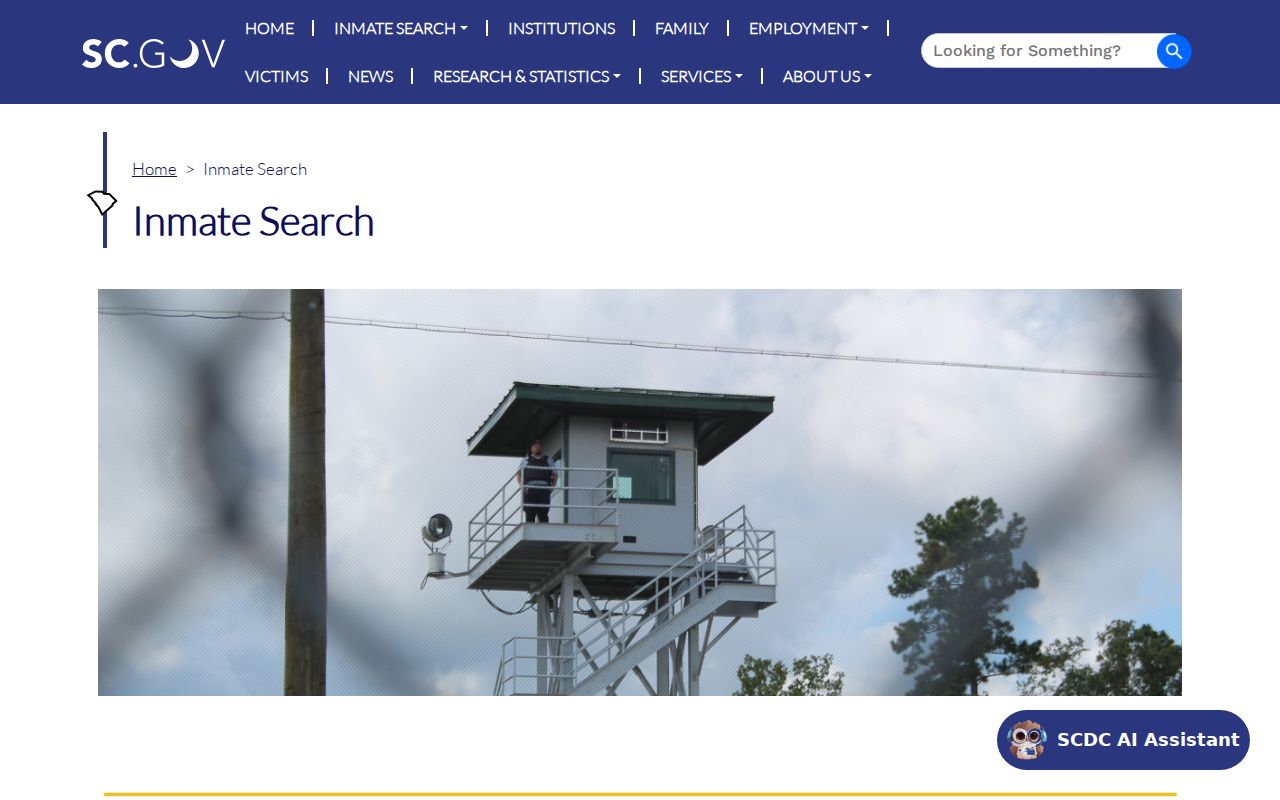
The SCDC screen does not cover county detainees, released people, juveniles, fugitives, or people only on community supervision.
For recent confinement, South Carolina FOIA §30-4-30(D)(3) requires identifying documents for people confined during the prior three months to be available for inspection or copying during operating hours unless exempt. Older booking material may require a focused request to the regional center and the arresting agency. State prison custody, county detention, and Lee court status should never be treated as interchangeable.
What a Lee County Criminal Record Shows
The fields depend on the custodian. A Lee County court entry can show a linked case number, party role, court and case type, filed or disposed dates, docket actions, status, and available case detail. An arrest or booking file may add aliases, physical descriptors, arrest-stage charges, fingerprints, and custody facts. Some of that data is not public. Victim information, juvenile material, medical or security details, confidential sources, and active-investigation content may be withheld or redacted.
| Name and identifiers | Names, aliases, birth data, and agency identifiers where lawfully released. |
|---|---|
| Arrest and booking | Agency, date, alleged charge, intake, bond, and custody information. |
| Case activity | Filed charge, hearings, motions, plea, trial, and docket events. |
| Disposition | Dismissal, acquittal, conviction, or other recorded outcome. |
| Sentence | Custody, fine, probation, or other terms shown in the court file. |
| Current status | Separate jail, SCDC, or SCDPPPS source needed for present custody or supervision. |
A name match is not a fingerprint match. Compare known dates and the actual court file before deciding that a Lee County criminal record belongs to the intended person.
Lee County Criminal Record Gaps
SLED reported in July 2026 that only seven percent of direct indictments from 2025 forward had entered the state criminal-history repository. The agency chiefly tied the gap to subjects who had not been fingerprinted. That finding matters in Lee County because a direct indictment can exist in the court system without appearing as expected in CATCH. It also shows why a no-result screen is not a clean-record certificate.
South Carolina law requires covered fingerprints to reach SLED within three days, excluding weekends and holidays, but transmission and later disposition matching can still fail. The safe check is layered: inspect the Lee court index, contact the correct court, obtain local arrest or detention material when relevant, and compare it with CATCH. If CATCH conflicts with a certified case file, use SLED's CJIS challenge channel. An FBI-summary error follows the FBI challenge process instead.
Note: Each custodian can correct only the record it maintains; a clerk cannot directly rewrite SLED's repository entry.
Public Access Laws for Lee County Criminal Records
The South Carolina Freedom of Information Act governs access to public-body records. It does not erase limits for privacy, fair-trial rights, active enforcement, confidential sources, investigative methods, or safety. The actual custodian matters. A sheriff report, Sumter-Lee booking file, Lee court docket, CATCH history, prison locator, and registry profile are different records held under different duties.
Key South Carolina laws:
Title 30, Chapter 4 sets FOIA access, timing, fee, and exemption rules.
§23-3-120 supports state histories through required fingerprint submission.
§17-1-40 addresses destruction and sealing after qualifying dismissals or not-guilty outcomes.
§§17-22-910 through 950 govern South Carolina expungement administration.
§23-3-490 authorizes public sex offender registry dissemination.
South Carolina FOIA generally requires an availability decision within 10 business days for records no more than two years old and 20 business days for older material. Those are decision periods, not promises that every record is public or ready at once.
Lee County Sheriff Record Requests
No dedicated Lee County Sheriff online request portal or county fee schedule was found in official sources. The dependable local route is the Sheriff's Office at 113 Gregg Street, Bishopville, SC 29010, 803-484-5353. Identify the event, date and time range, place, agency, report or booking number, and exact record sought. Ask first whether the Sheriff or another police agency owns the file.
For a formal request, cite South Carolina FOIA and seek releasable incident, arrest, booking, warrant-service, jail-transfer, or administrative material. Ask for electronic delivery, a cost estimate, and nonexempt portions with redactions. The SLED FOIA page is a separate state channel for records that SLED itself holds.
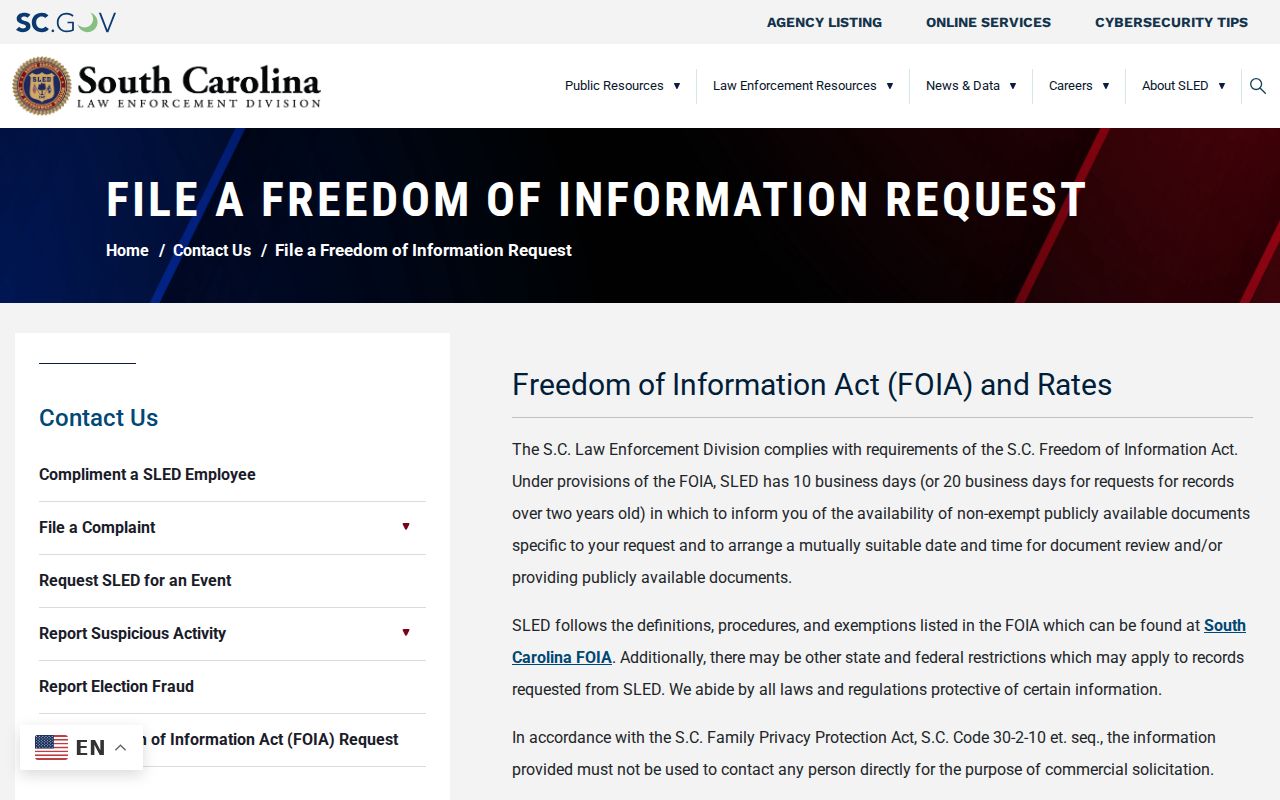
The posted SLED schedule is only a state benchmark: $20 per hour for scanning or redaction, $25 per archival box, $5 per disc, and $0.15 per page, with a possible 25 percent deposit. Those are not Lee County Sheriff's fees.
The Lee County Sheriff's Office-SC app can send safety, road, weather, and event notices and accepts anonymous multimedia tips. Its store descriptions do not advertise inmate, warrant, booking, records-request, crime-map, or registry search tools. Use the office and official custodians for records rather than assuming the app hides a lookup.
Sealed, Expunged, and Restricted Records
Juvenile files, expunged or sealed matters, protected victim and minor identifiers, Social Security numbers, and sensitive account data are not ordinary public-index material. Expungement depends on the charge, outcome, prior history, and statute. It is not a general request to delete an unfavorable item.
For a Lee County General Sessions matter, the Third Circuit Solicitor handles the application route. A dismissed Magistrate or Municipal matter starts with that court. The Third Circuit Solicitor's Office verifies eligibility, gathers required signatures, files the order, and distributes it to affected agencies.
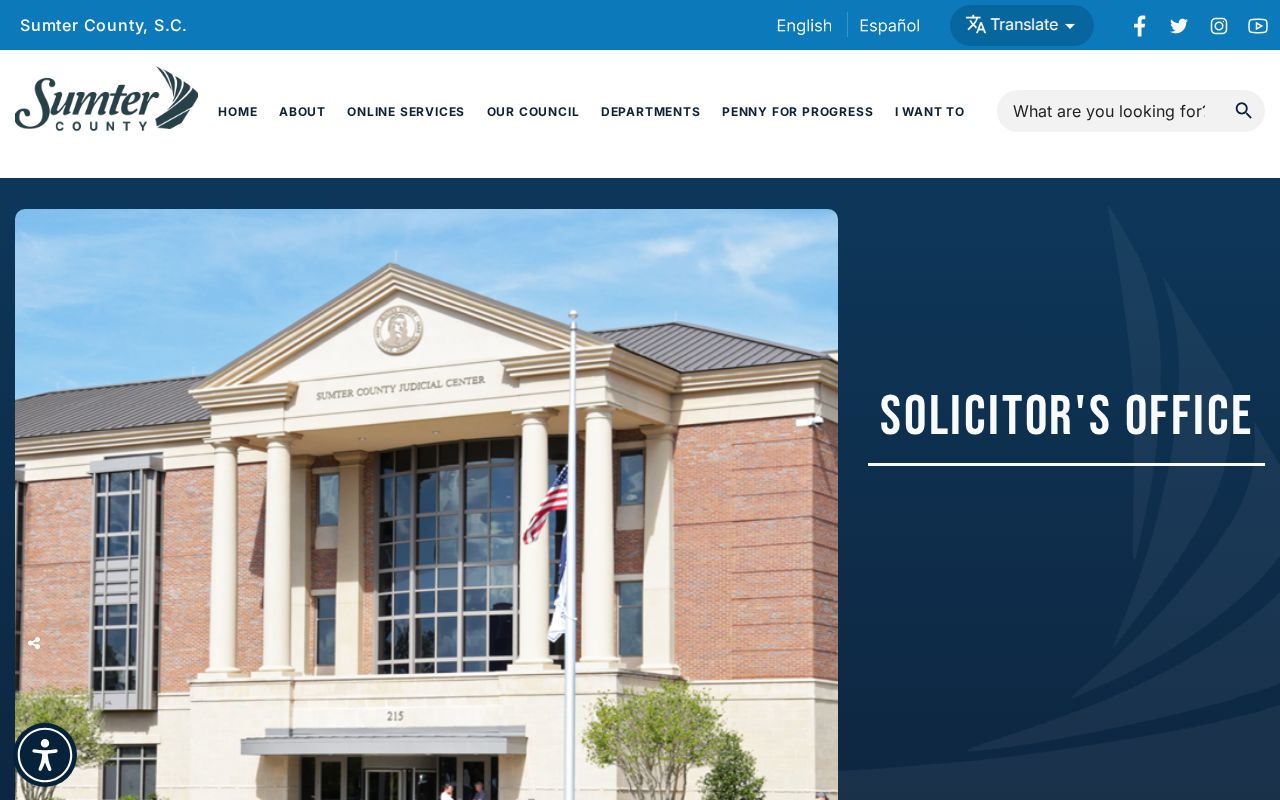
This prosecutor channel serves Lee County and differs from a request to the clerk or SLED.
State law sets a $25 SLED verification fee with listed exceptions, but the research did not locate a complete Lee County total. SLED advises allowing four weeks after it receives an order, then checking CATCH. If the removed charge remains, send SLED a certified true copy of the order, a recent CATCH report, and a self-addressed stamped envelope through its stated correction process. A pardon is separate from expungement.
Lee County Supervision and Prison Records
Probation and parole in Lee County are state-run through the South Carolina Department of Probation, Parole and Pardon Services. Its Lee office is in Room 213 of the courthouse, with phone 803-484-5341 extension 344. The active-supervision search can use name, SID number, county, or year of birth in approved combinations.
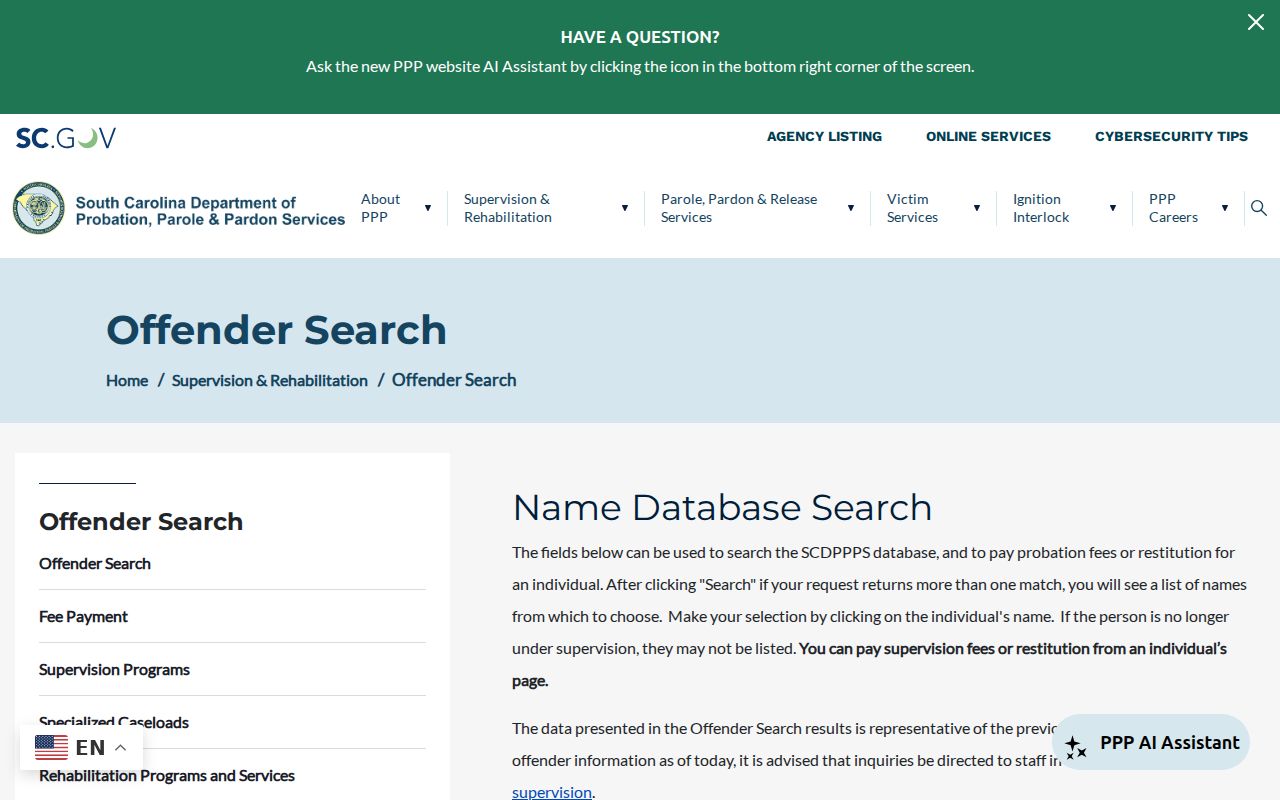
Its results reflect the prior day, and formerly supervised people may not appear, so the Lee office remains the current-status check.
The Lee County SCDPPPS directory provides the local supervision contact.
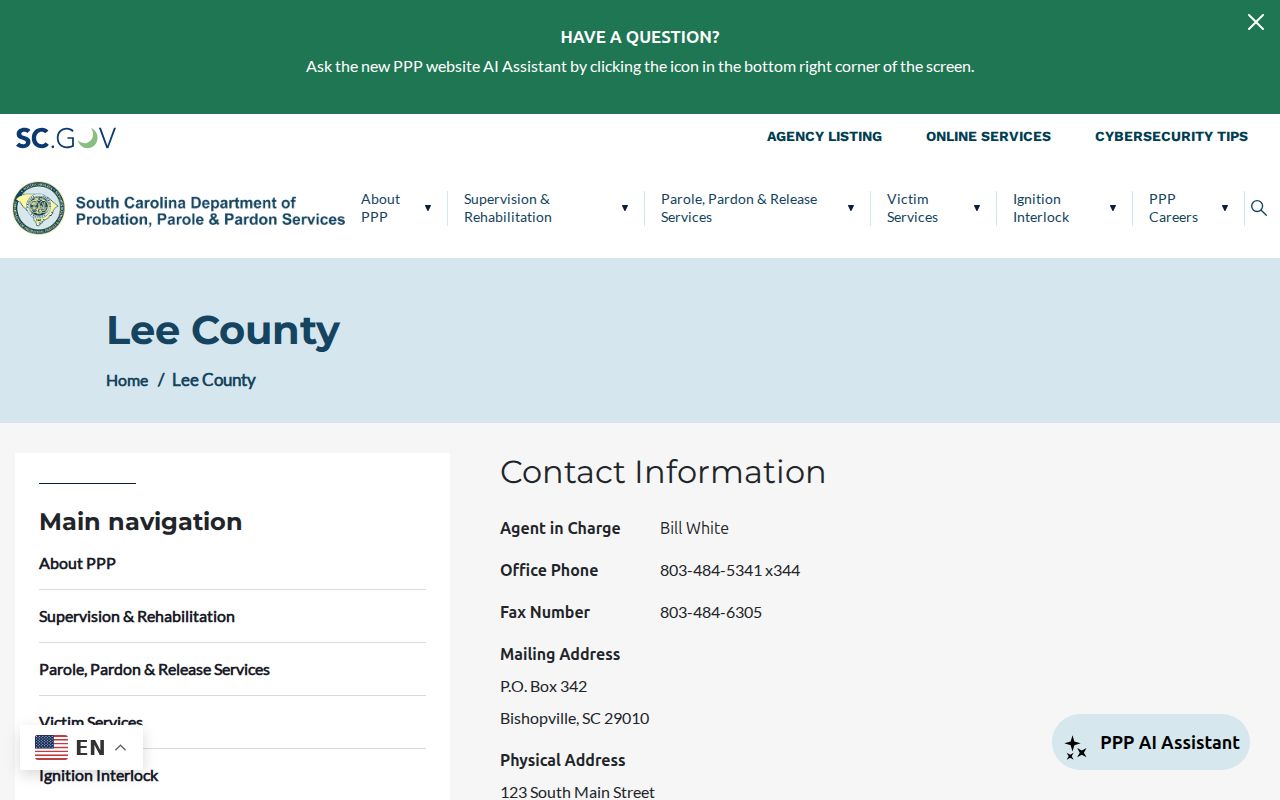
This office should not be confused with SCDC, which covers state prison custody, or Sumter-Lee, which holds county detainees. Lee Correctional Institution is a state prison, not Lee County's booking jail.
Criminal Records by City in Lee County
Lee County has only two incorporated places in the official 2020 Census table. Bishopville is the county seat and has a police department and municipal court at East Council Street. Lynchburg has a much smaller municipal footprint, and current official local records channels are sparse. City reports stay with the agency that made them, while custodial bookings route to Sumter-Lee and filed cases move through the proper city or county court.
Bishopville Criminal History
Population 3,062 · Police, municipal court, ticket, and booking routes
Lynchburg Criminal History
Population 318 · Public Index, summary-court, and agency fallbacks
Do not add an unincorporated place to force a third city search. A report created by Bishopville Police is not automatically a Sheriff's Office report, and uncertainty about a Lynchburg event should be resolved from the citation or report before choosing a custodian.
Lee County Registry Records Stay Separate
The South Carolina Sex Offender Registry Tool, called SORT, does not sit inside CATCH. Lee County entries are searched through the Lee SORT portal after the user accepts lawful-use terms and completes a captcha. Name and geographic searches serve different needs, while Community Notifications supplies the alert route. The Sheriff's Office at 113 Gregg Street is the local registration contact.
The official Lee County SORT conditions screen precedes all registry search tools.
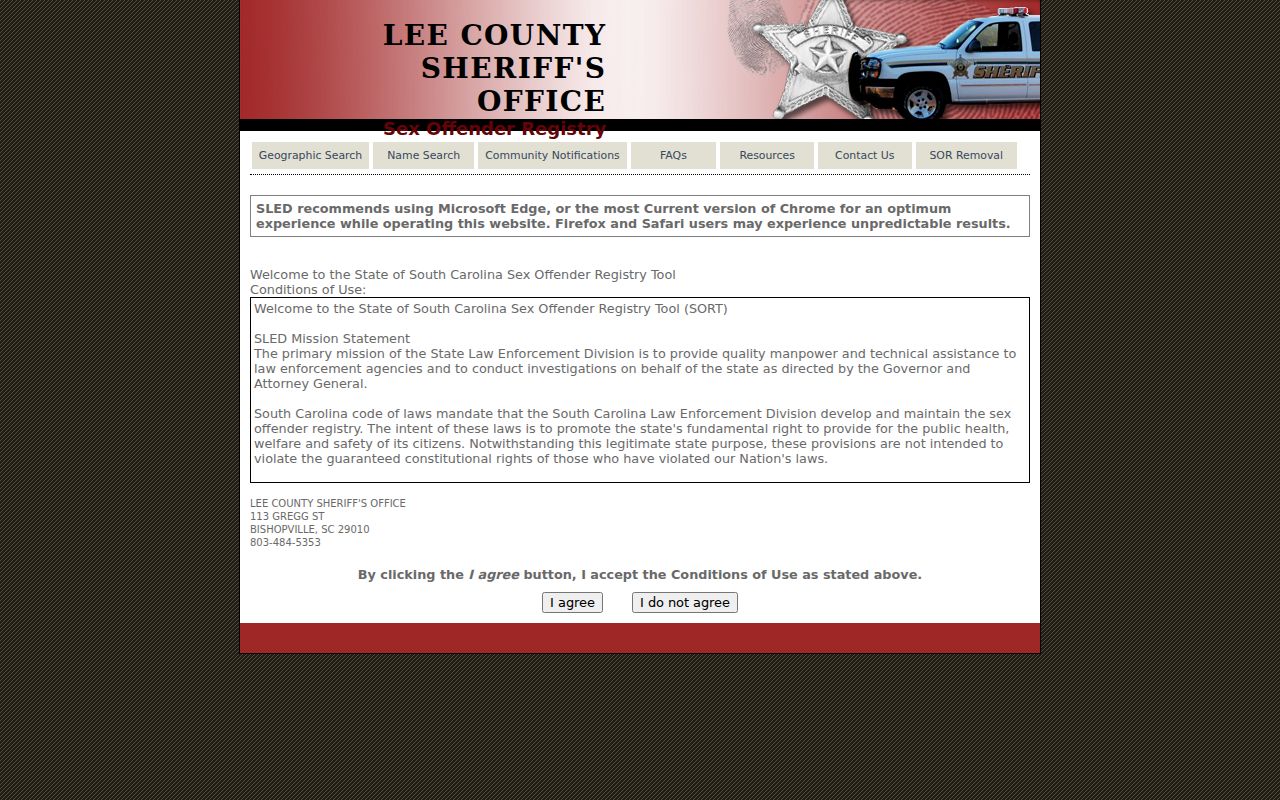
The conditions matter because registry data can change quickly, may include registrant-supplied facts, and must not be used to harass or threaten anyone.
Use the Lee County sex offender check process for the full search-field, verification, tier, and lawful-use details. For places outside South Carolina, the National Sex Offender Public Website is the correct cross-state layer. Report a suspected error or noncompliance to the Sheriff or SLED rather than confronting a listed person.
Historic Lee County Criminal Records
Lee County's current record system has roots in the county's creation in 1902. Court first met in Bishopville's Opera House in 1903. The purpose-built courthouse followed in 1908 and 1909, and its classical facade still spells out “LEE COVNTY COVRT HOVSE.” The South Carolina Archives extends a records search beyond today's portal with General Sessions criminal journals from 1903 through 1933, Magistrate criminal dockets from 1907 through 1933, and sheriff jail books from 1917 through 1941.
Those archival series can help with genealogy and historical case research, but they are not present-custody or active-warrant tools. Start with the Archives' Lee County record guide for old material and the modern clerk for a current certified file. The building's history also explains why “the courthouse” is not one all-purpose counter: General Sessions and the clerk are at South Main Street, Magistrate and Bond Court are at 115 Gregg Street, and the Sheriff is next door at 113 Gregg Street.
Note: Official sources do not publish counter hours, parking, security, or device rules, so call the correct Lee County office before travel.